RE-2012 Rotary Evaporator: Technical Review and Research Case Studies
Examine the technical capabilities, motor-driven lifting system, 10–310 RPM rotation range, and research applications of the BIOBASE RE-2012 Rotary Evaporator.
By Muhammad Satrio · · 10 min read
In natural product chemistry, pharmaceutical laboratories, biotechnology research facilities, and environmental testing centers, separating volatile solvents from less volatile compounds is a common laboratory operation. Atmospheric distillation can require substantial heating and may expose heat-sensitive compounds to temperatures that cause degradation.
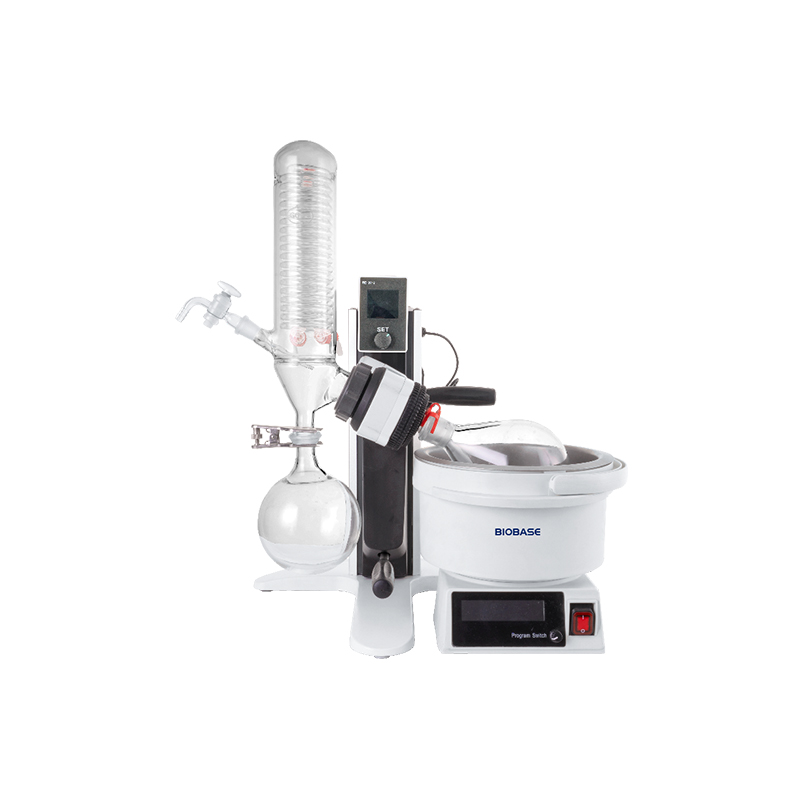
The RE-2012 Rotary Evaporator, manufactured by BIOBASE Group, is designed to facilitate solvent evaporation under reduced pressure. By combining flask rotation, controlled heating, vacuum distillation, and vapor condensation, a rotary evaporator can help remove solvents at lower temperatures than those required under atmospheric pressure.
The rotating flask spreads the sample across its inner surface, increasing the area available for evaporation. Vapor then passes through a condenser, where it cools and collects in a receiving flask. Actual evaporation performance depends on the solvent, pressure, bath temperature, rotation speed, condenser temperature, and sample properties.
A. Technical Specifications of the BIOBASE RE-2012
Evaluating a rotary evaporator requires consideration of its mechanical construction, heating capacity, rotational speed, lifting mechanism, condenser design, and vacuum sealing system.
The following specifications are based on the product information provided for this review. Confirm them against the manufacturer's current documentation and the exact configuration offered by the supplier.
| Parameter | RE-2012 Specification | Technical Relevance |
|---|---|---|
| Evaporating flask capacity | 1 L with 29# standard ground-glass joint | Determines the nominal flask capacity and glassware connection |
| Receiving flask capacity | 1 L with 35# spherical joint | Collects condensed solvent during evaporation |
| Rotational speed | 10–310 RPM, stepless digital control, forward and reverse rotation | Allows adjustment of flask rotation for different samples and operating conditions |
| Evaporation rate | Up to 23 mL/min, depending on the solvent | Indicates the stated maximum evaporation performance under specified conditions |
| Heating power | 1,300 W | Provides energy for heating the bath |
| Heating temperature range | Ambient temperature to 99°C | Supports temperature-controlled evaporation |
| Heating bath | 4.6 L SUS304 stainless steel water/oil bath | Provides a temperature-controlled heating medium |
| Lifting system | Automatic electric lift with a 170 mm vertical stroke | Raises or lowers the evaporating flask |
| Condenser | Vertical double-coil condenser, approximately 80 × 370 mm | Provides a surface for cooling and condensing solvent vapor |
| Condensing surface area | 0.15 m², as listed in product information | Helps assess the available condensation area |
| Vacuum sealing | PTFE and fluororubber (FKM) composite seal | Supports sealing around the rotating assembly |
| Charging valve | 19# PTFE charging valve | Provides a route for introducing additional liquid when the system configuration permits |
| Motor | 30 W rotary motor | Drives the rotating flask |
| Frame | Aluminum alloy frame with an anti-corrosion finish | Supports the main mechanical assembly |
| Dimensions | Approximately 600 × 400 × 640–810 mm | Indicates the approximate benchtop footprint and operating height |
| Net weight | Approximately 11.5 kg | Helps assess handling and installation requirements |
Note: The listed evaporation rate, temperature stability, vacuum performance, and other operating characteristics should be verified with the manufacturer. The 0.15 m² condenser area and other detailed specifications should also be checked against the current product datasheet.
B. Evaluating the RE-2012's Value Proposition
When selecting a benchtop rotary evaporator, laboratories must balance operating requirements, ease of use, glassware compatibility, maintenance, and acquisition cost. The RE-2012 offers several features worth evaluating for academic, research, and industrial laboratory applications.
1. Adjustable Rotation Speed up to 310 RPM
The RE-2012 is listed with a rotational speed range of 10–310 RPM and stepless digital control.
Flask rotation spreads the liquid sample over the inner glass surface, increasing the area available for heat transfer and evaporation. The appropriate speed depends on the solvent, sample viscosity, flask filling level, vacuum conditions, and tendency to foam or bump.
The listed forward and reverse rotation capability may provide additional flexibility for certain workflows. However, its availability and intended use should be confirmed with the supplier. Rotation speed alone does not guarantee higher throughput or prevent bumping.
2. Automatic Electric Lifting System
The RE-2012 features a motorized lifting mechanism with a listed vertical stroke of 170 mm.
An electric lift allows the operator to raise or lower the evaporating flask without relying entirely on manual adjustment. This can simplify routine operation and help control the flask's position relative to the heating bath.
Lifting the flask out of the bath can stop further direct heating, but it does not immediately cool the sample. Laboratories should verify the instrument's behavior during power failure and confirm whether any automatic lift or fail-safe function is provided.
3. PTFE and FKM Vacuum Sealing
Vacuum integrity is an important factor in rotary evaporation because reduced pressure allows solvents to boil at lower temperatures.
The RE-2012 is listed with a composite sealing system incorporating PTFE and fluororubber (FKM). PTFE offers broad chemical resistance, while FKM provides elasticity in suitable sealing applications.
Compatibility depends on the specific solvent, concentration, temperature, exposure duration, and seal formulation. Buyers should confirm chemical compatibility with the manufacturer, particularly when working with aggressive solvents or mixtures.
4. Charging Valve for Liquid Addition
The instrument is listed with a 19# PTFE charging valve.
A charging valve may allow liquid to be introduced into the evaporating flask during operation, depending on the arrangement of the feed tubing and vacuum system. This can reduce interruptions in workflows that involve repeated additions of compatible sample solutions.
Continuous feeding should not be assumed to be available under every operating condition. Confirm the required tubing, valve configuration, maximum practical feed rate, and operating procedure with the supplier before using this feature.
C. What to Consider When Evaluating a Rotary Evaporator
Selecting a rotary evaporator involves more than comparing maximum rotation speed or heating power. The instrument must match the solvent properties, sample volume, required recovery rate, and laboratory safety requirements.
1. Vacuum Control and System Tightness
Reduced pressure lowers a solvent's boiling temperature, allowing evaporation at temperatures that may be more suitable for heat-sensitive compounds.
The required operating pressure depends on the solvent and the desired bath temperature. For example, water and dimethylformamide (DMF) have atmospheric boiling points of approximately 100°C and 153°C, respectively, but their boiling temperatures change under reduced pressure.
Before purchasing, consider:
- Compatibility with the intended vacuum pump and vacuum controller.
- Vacuum stability and leakage under operating conditions.
- Chemical compatibility of seals and connecting components.
- Pressure monitoring and control requirements.
- Safe handling of solvent vapor and exhaust.
Do not assume that a particular vacuum level or evaporation temperature can be achieved without checking the complete system configuration.
2. Condenser Efficiency and Cooling Capacity
The condenser must remove sufficient heat from the solvent vapor to achieve effective recovery.
The RE-2012 is listed with a vertical double-coil condenser and a stated condensing surface area of 0.15 m². Actual condensation performance depends on the solvent, vapor load, cooling temperature, coolant flow rate, and system pressure.
When planning a rotary evaporation setup, evaluate:
- Condenser geometry and available surface area.
- Chiller capacity and coolant flow.
- Appropriate coolant temperature for the solvent.
- Vacuum pump protection and solvent-vapor management.
- The need for a secondary cold trap.
A condenser that cannot keep up with the vapor load may allow solvent to reach the vacuum pump or escape into the exhaust system. Appropriate cooling and vapor-management equipment help reduce these risks.
3. Heating Bath Safety and Temperature Control
Heating bath capacity, temperature range, control stability, and construction affect everyday operation.
The RE-2012 is listed with a 4.6 L SUS304 stainless steel bath and a temperature range from ambient temperature to 99°C.
Before purchase, confirm:
- Temperature control accuracy and uniformity.
- The type and placement of the temperature sensor.
- Protection against overheating and low bath levels.
- Electrical protection and applicable safety certifications.
- Compatibility with water or oil as the heating medium.
- Safe operating procedures for hot liquids and glassware.
A stated temperature range does not establish temperature accuracy. Request the manufacturer's specifications for temperature stability and independent safety features.
4. Glassware Compatibility and Joint Standards
Glassware connections determine whether evaporating flasks, receiving flasks, condensers, and accessories fit together correctly.
The RE-2012 is listed with a 29# evaporating-flask joint and a 35# spherical receiving-flask joint. These designations should be confirmed against the manufacturer's joint dimensions and the actual glassware supplied.
Before purchasing replacement components, verify:
- Joint type and dimensions.
- Compatibility with the condenser and receiving assembly.
- Flask capacity and geometry.
- Availability of replacement glassware and seals.
- Compatibility with bump traps and other accessories.
Do not assume that joint designations are interchangeable across different standards or suppliers.
D. Research Applications and Illustrative Case Studies
Rotary evaporation is used in natural product research, organic synthesis, pharmaceutical development, and environmental analysis. The following examples illustrate potential applications of an instrument with suitable heating, rotation, vacuum, and condensation capabilities. They are illustrative workflows, not reports of experiments performed specifically with the RE-2012.
Case Study 1: Concentrating Plant Extracts and Heat-Sensitive Phytochemicals
Natural product researchers often prepare extracts containing flavonoids, polyphenols, pigments, and other compounds from plant materials such as green tea leaves and medicinal herbs.
Example workflow
- Extract plant material using a suitable solvent, such as ethanol or methanol, according to the research protocol.
- Filter or otherwise clarify the extract when necessary.
- Transfer an appropriate volume to a compatible evaporating flask without exceeding the recommended filling level.
- Select the bath temperature and vacuum pressure based on the solvent and the thermal stability of the target compounds.
- Rotate the flask at a suitable speed and collect the condensed solvent.
- Analyze the concentrated extract using an appropriate analytical method.
Research relevance
Reduced-pressure evaporation can help remove solvents at lower temperatures than atmospheric distillation. This may reduce thermal exposure for sensitive compounds, although degradation can still occur depending on temperature, oxygen exposure, light, and processing time.
Solvent recovery and extract concentration should be validated for the specific sample and intended analytical or preparative application.
For further reading, consult the Food Chemistry journal from Elsevier.
Case Study 2: Solvent Removal in Organic Synthesis
Organic synthesis laboratories frequently use rotary evaporation during reaction workup to remove volatile solvents from crude reaction mixtures.
Example workflow
- Complete the reaction and perform the required extraction and separation steps.
- Dry the organic phase when appropriate and remove suspended drying agents by filtration.
- Transfer the prepared solution into a compatible evaporating flask.
- Select operating pressure, bath temperature, and rotation speed based on the solvent and product properties.
- Evaporate the solvent and collect the condensate in the receiving flask.
- Prepare the remaining residue for further purification or characterization.
Research relevance
Rotary evaporation can reduce the time needed to remove bulk solvent during routine workup. Controlled pressure and rotation can also help manage foaming and bumping, although these problems may still occur.
The recovered residue may subsequently be purified using flash chromatography or characterized by methods such as nuclear magnetic resonance (NMR) spectroscopy.
For relevant research publications, visit the ACS journal Organic Process Research & Development.
Case Study 3: Concentrating Environmental Samples for Analysis
Environmental laboratories may need to concentrate extracts from water, soil, or sediment before instrumental analysis.
Depending on the analytical method, extraction solvents may contain target compounds such as pesticide residues or other organic pollutants.
Example workflow
- Collect and prepare environmental samples according to a validated method.
- Extract target compounds using the specified solvent system.
- Perform any required cleanup and phase separation.
- Concentrate the extract under suitable pressure and temperature conditions.
- Transfer the concentrate into a compatible vial for analysis by gas chromatography–mass spectrometry (GC-MS) or another validated analytical technique.
Research relevance
Rotary evaporation may help reduce solvent volume before instrumental analysis. However, analyte volatility, thermal stability, and interactions with the solvent must be considered to avoid losing target compounds during concentration.
Solvent recovery percentage and analytical recovery are different measurements. A high percentage of solvent recovered does not establish that the target analytes have been retained quantitatively.
Environmental laboratories should follow validated analytical methods and verify recovery using appropriate quality-control procedures.
For further reading, explore the Royal Society of Chemistry's Green Chemistry journal.
E. References and Further Reading
- BIOBASE Group. RE-2012 Rotary Evaporator. Official product information.
- Made-in-China. BIOBASE RE-2012 Rotary Evaporator. Product listing and technical information.
- Elsevier. Food Chemistry. Journal and research articles.
- American Chemical Society. Organic Process Research & Development. Journal and research articles.
- Royal Society of Chemistry. Green Chemistry. Journal and research articles.
For a visual demonstration of rotary evaporation, see the BIOBASE RE-100 Pro Rotary Evaporator demonstration. The video may help illustrate the general operating principle, but it should not be treated as confirmation of the RE-2012's specific features or performance.
- rotary evaporator
- RE-2012
- biobase
- solvent recovery
- vacuum distillation
- laboratory equipment